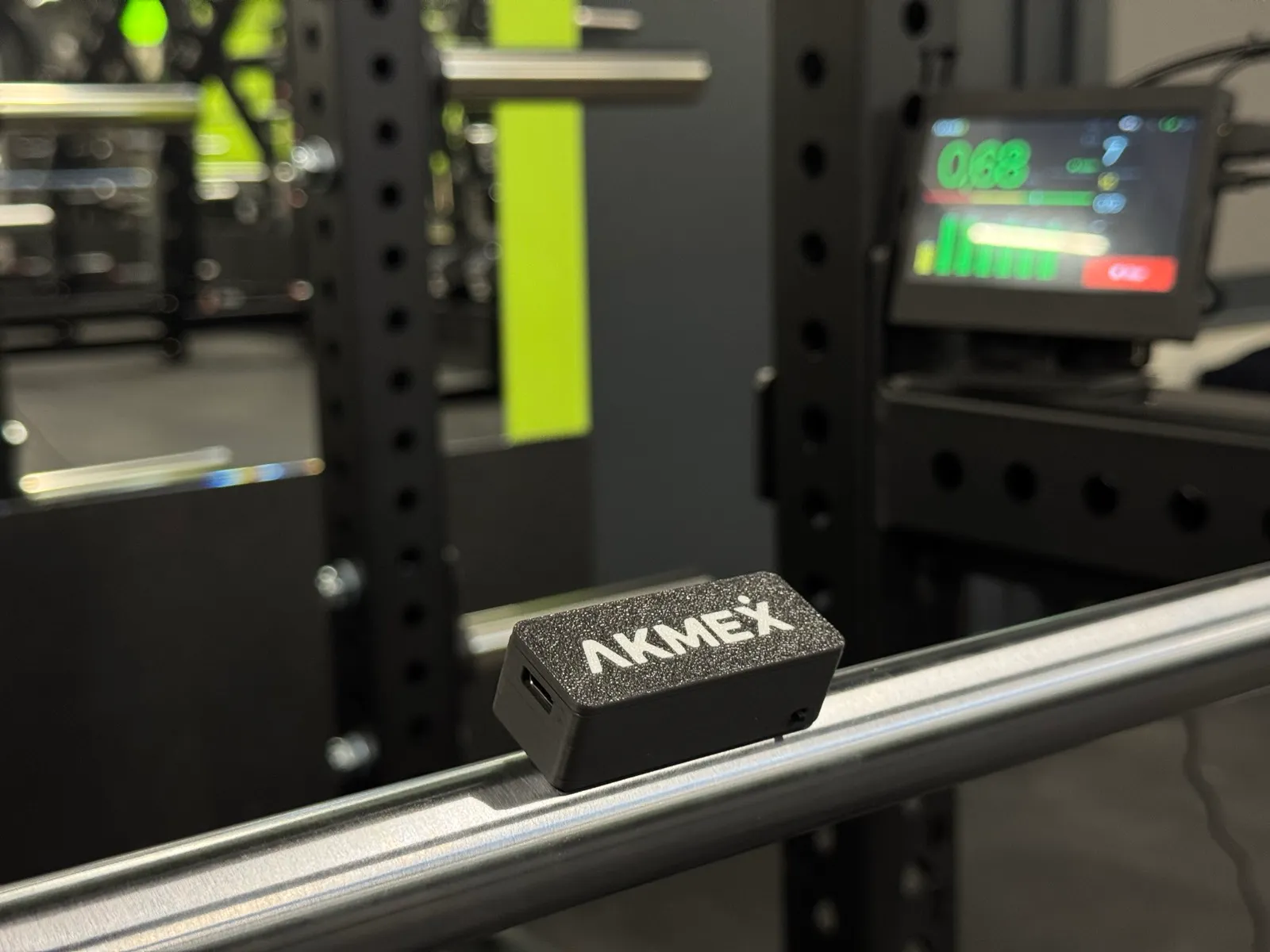
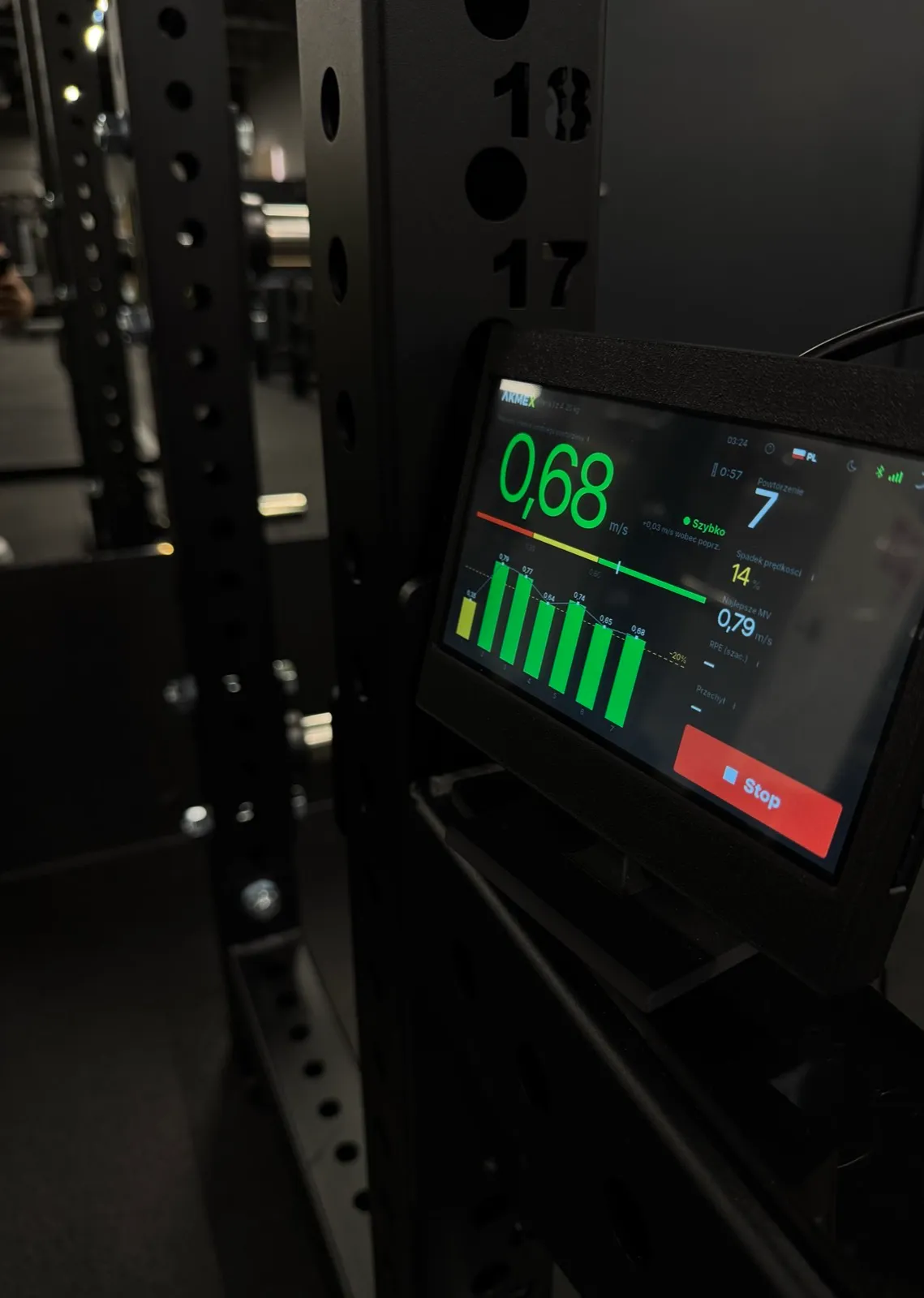
The AKMEX Node sensor measures the velocity of every rep, and the result is shown in real time on the connected device. Athletes and coaches get reliable data after every set to analyse.

  • Data after every rep
  • Charts and a report after every set
  • PDF report for the whole session
  • Four languages
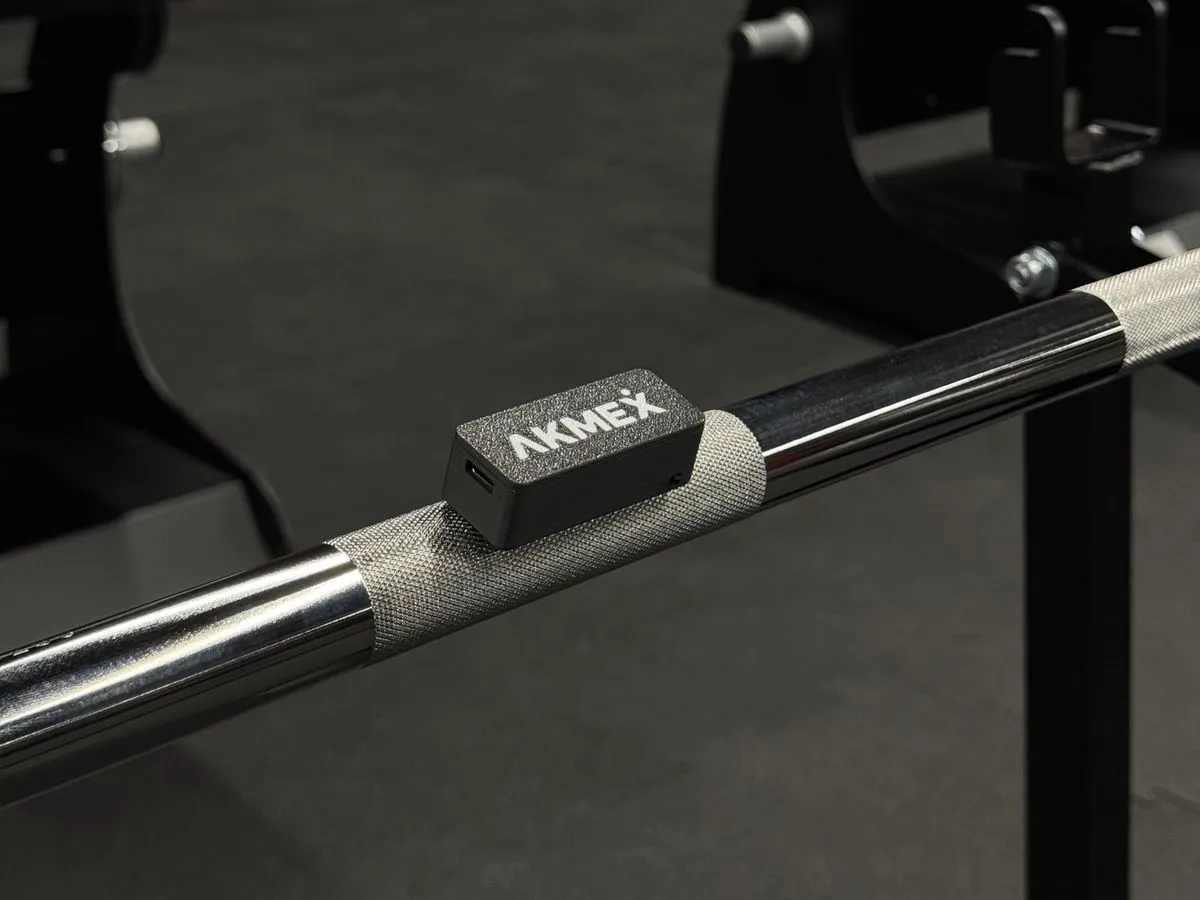
AKMEX Node attached to a barbell in a gym

Plates show what you lifted. Velocity shows how it went.

The same weight can feel light today and be at your limit next week. Velocity shows the difference that plates never will.

Fatigue in numbers

Velocity loss shows how hard the set was.

Form, day to day

Same weight, different velocity: you see how you feel today.

The right load

Velocity tells you whether the weight is too light or too heavy.

Fatigue shows in velocity.

AKMEX calculates the mean velocity of every rep and the velocity loss during the set. Each exercise also has a limit velocity, and the colour of a bar shows how far from it you are.

Rep1 / 6
0.00m/s
In reserve
Velocity loss0 %

The fastest rep of the set. Velocity loss is measured from it.

Sample set: bench press, 80 kg, 6 reps

Mean velocity of six reps Velocity drops with every rep, fastest in the last two: 0.55, 0.53, 0.48, 0.42, 0.34, 0.25 m/s.
In reserve Nearing the limit At the limit velocity trend
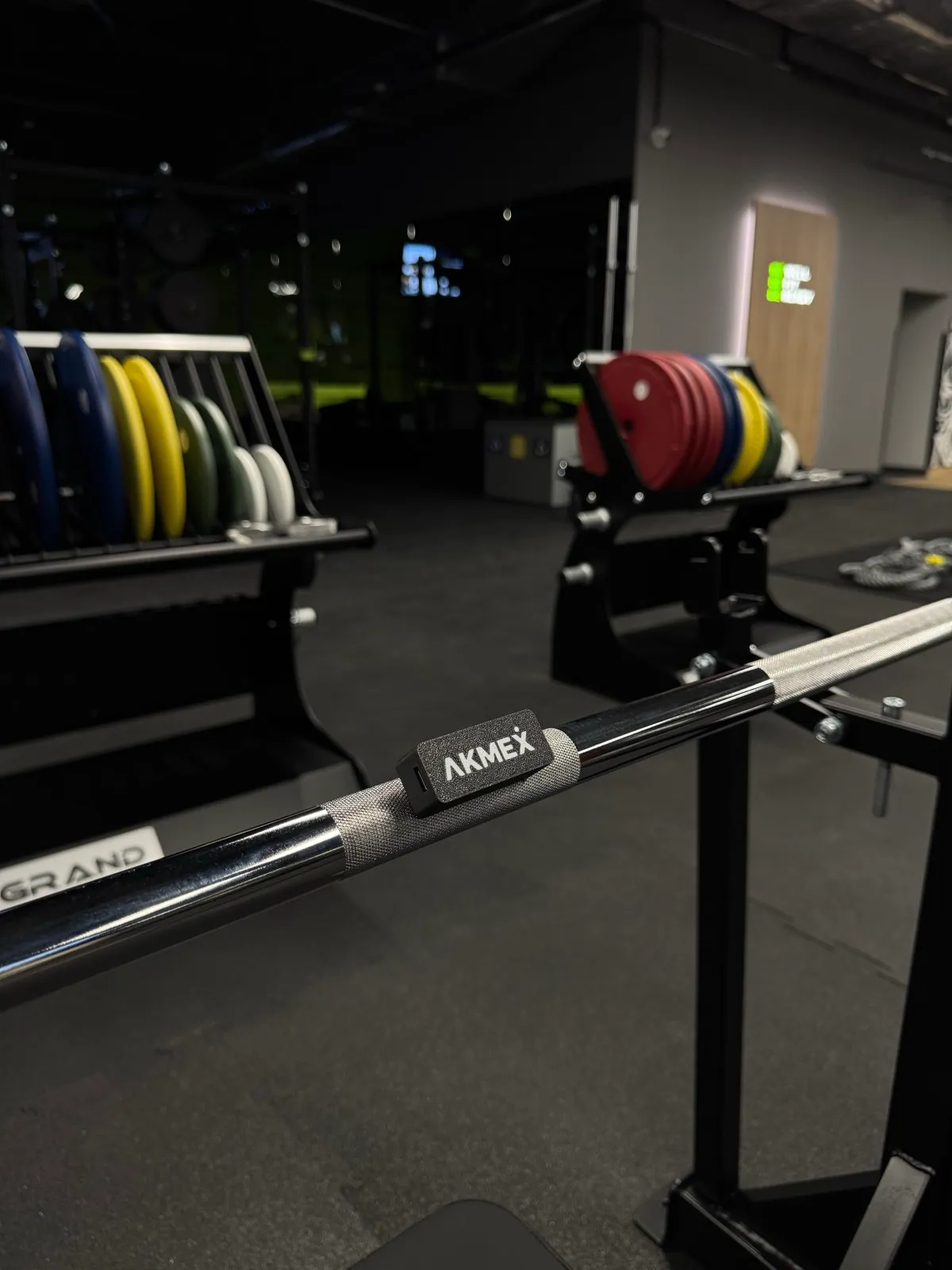
AKMEX Node attached to a barbell, with a rack and plates in the background

Attach. Lift. Review.

A compact bar velocity sensor that attaches to a barbell, a cable stack weight or a dumbbell. It records movement with an inertial measurement unit (IMU) sampling at 208 Hz and sends the data to the host device.

In the background, an algorithm calculates the result of every rep as you train. After the set it recalculates the data once more, applies any corrections and shows the summary.

Weight 30 g The whole device.
Size 6 × 2.4 × 1.8 cm Length, width and height of the case.
Mounting 5 magnets Neodymium: 4 small and 1 large. A strap adds security for dynamic lifts such as the deadlift.
Sampling 208 Hz Inertial measurement unit: accelerometer and gyroscope.
Power 470 mAh Li‑Po battery. Long battery life.
Connection Bluetooth LE Wireless to the host device: Hub, tablet or phone.

Lift. Measure. Compare.

  1. Attach Node

    Magnets hold the sensor on a barbell, a cable stack weight or a dumbbell. Add the strap for dynamic lifts.

  2. Start the system

    Hub, tablet or phone. Pick the exercise and enter the weight.

  3. Do your set

    Calibration takes a few seconds, then you train as usual. The device records data automatically, shows the velocity after every rep and plays a sound.

  4. Review the result

    Velocity after every rep, a report after the set and a history to compare against.

Many setups.

Node is always the same. You choose the rest of the system to fit how your club works: a fixed station, a tablet or a phone.

AKMEX Hub next to a rack showing velocity during a set
Fixed station

AKMEX Hub

A ready-made device with a 7″ touch display. Switch on the power and start training.

  • Wall mount next to a rack or bench
  • Open to everyone training in the gym
  • Several user profiles on one station
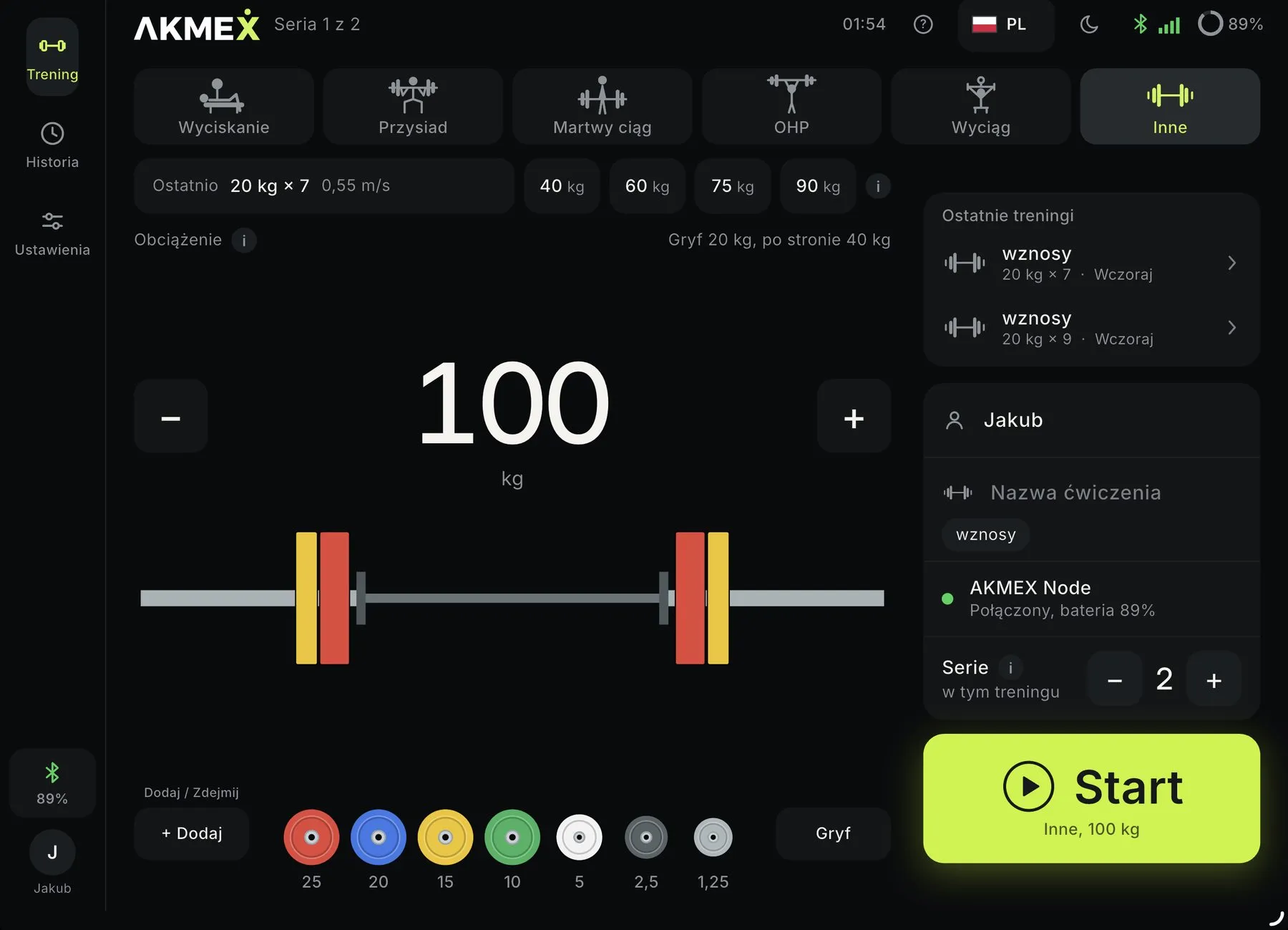
Training view of the AKMEX app on an iPad: exercise choice, weight and the Start button
Tablet

AKMEX app on a tablet

A tablet with the AKMEX app next to the station, mounted permanently or brought by the athlete or coach.

  • A large display readable for athlete and coach
  • PDF session report straight from the tablet
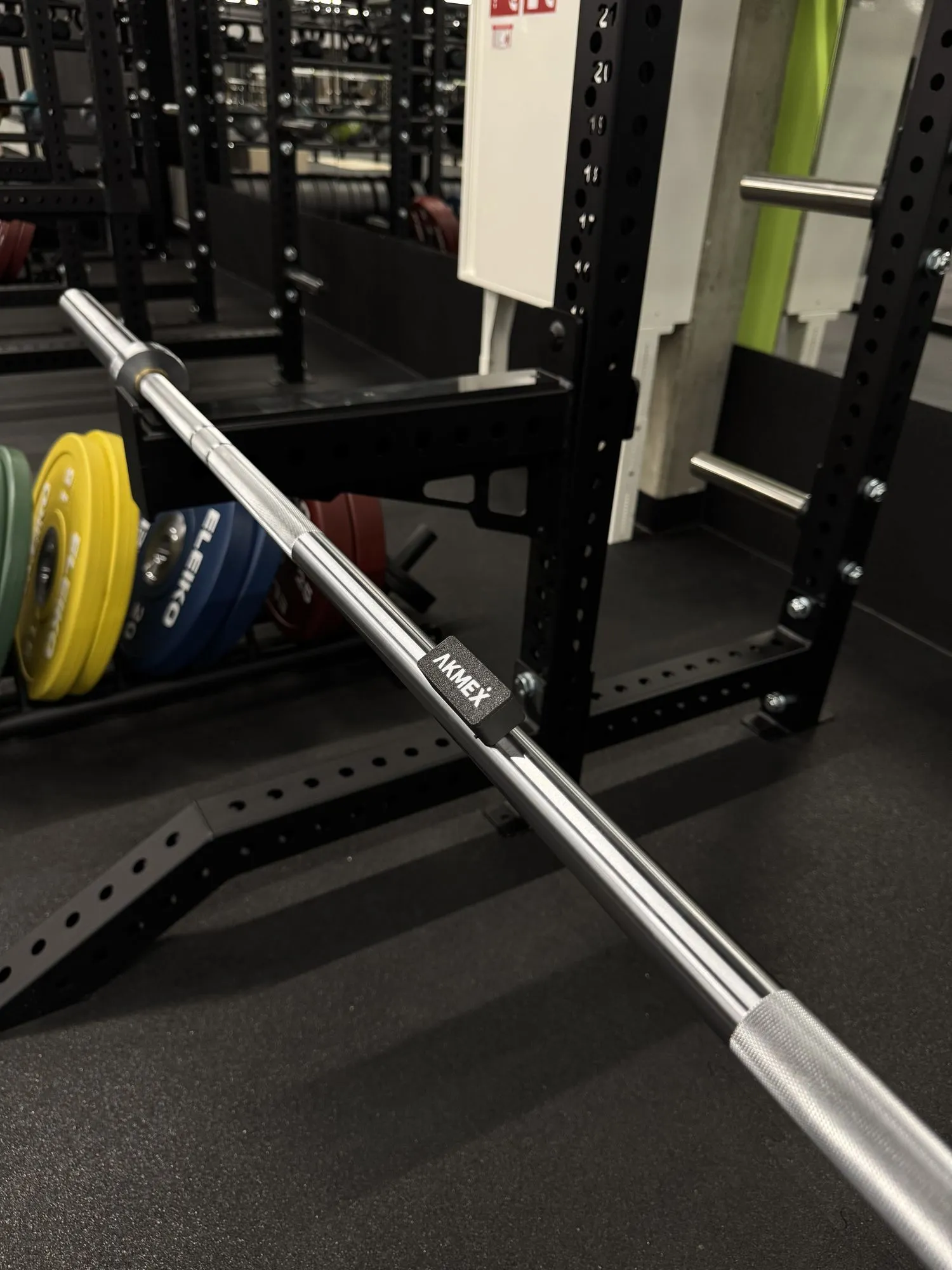
AKMEX Node attached to a barbell
Phone

AKMEX app on a phone

A club member pairs Node with the AKMEX app on their own phone and trains.

  • The simplest start for a club
  • Data stays on the phone

AKMEX app for iOS and Android: coming soon.

A report after every set. A summary after the session.

Right after a set you see all the numbers and charts. After the session everything is collected in a summary you can send on as a PDF.

  • Set reportRep count, best and mean MV, velocity loss, mean power, training volume and set time. MV and PV charts and a table of every rep.

  • Session summaryNumber of sets and reps, training volume, best and lowest MV with the set and rep number, and a comparison of sets. Every set has its own card with a chart.

  • PDF reportThe whole summary with rep tables for every set. Send it to your coach via AirDrop, e‑mail or a messenger.

  • Training historyThe same weight week after week: a trend in form instead of a single result.

MV: mean velocity of a rep. PV: peak velocity. ROM: range of motion.

Backed by research.

Measuring bar velocity has solid foundations in the scientific literature. Here are a few key findings.

Daily form

Lower than usual velocity at the same weight signals a drop in strength or more fatigue. You can adjust your training to how you are performing on the day.

Review of autoregulation methods, PeerJ, source
In real time

Immediate feedback after every rep helps keep the quality of a set and raises motivation.

Weakley et al., 2023, source
Progress

Meta-analyses found no significant difference between velocity-based training and percentage-based training in strength, jump and sprint gains. The effects are comparable, and you also track progress objectively from session to session.

Liao et al., 2021, meta-analysis, source
40 % fewer

In an 8-week squat study, one group ended sets earlier, at a smaller velocity loss. It did about 40 % fewer reps, yet strength gains were similar to the group that allowed a larger velocity loss. Less strain on the body, the progress stayed.

Pareja‑Blanco et al., 2017, 24 men, source

Honest about what it does

AKMEX will not replace measurement with a linear encoder, which is the gold standard in research but has its own limits, such as range of motion. AKMEX is a practical solution for the gym and for club members tracking their own training.

Why it pays off.

Every rep has a result you can analyse and compare.

AKMEX Node on a barbell in a gym with plate racks in the background

Sets your gym apart

A modern measurement station at the rack that sets your club apart and shows you invest in data.

Adds variety to training

Every rep gives concrete data to analyse and immediate feedback.

Ready reports for the coach

A member hands the coach a training report. The coach sees the data of every set, so they know how heavy each set really was.

Simple start

Switch the device on, do your set and check the results on AKMEX Hub, a tablet or a phone.

Data under control

Results are stored locally on the device, and the raw data of every set is kept.

Flexible model

Choose a permanently mounted station (AKMEX Hub + AKMEX Node) or Node on its own.

Try AKMEX in your club.

Get in touch and we will agree the device setup and the date of a presentation and trial. Then you decide whether you want AKMEX in your fitness club.

Contact us
Write to uskontakt@akmex.pl

We use your e‑mail address and message only to reply and to arrange a presentation or trial. Providing data is voluntary but needed to reply. You have the right of access, rectification, erasure, objection and to complain to the UODO. Details: Privacy policy.

  1. EnquiryWrite to kontakt@akmex.pl: tell us your club name and how many stations you are considering.

  2. ConsultationWe discuss your club’s needs and choose a setup: a fixed station, a tablet or Node on its own.

  3. Presentation and trialWe present the system and run a trial at your fitness club for an agreed period.

  4. Decision on working togetherAfter the trial we review the results, and you decide whether to adopt AKMEX in your club.